The Science Behind the Vibe — 01: What "I'm Stressed" Actually Means
A note before we start
I spent a lot of my career watching people go through the same cycle I was going through myself. The cyclical schedule, the ups and downs of work, the temporary relief. And noticing the gap between how we think we’re tackling stress versus what actually decreases it.
The most impactful thing I learned wasn’t a single technique but rather understanding how and why different mechanisms had different levels of impact. The shift that mattered most was moving from post-mortem to noticing in real time. Noticing is regulation, not in a therapy-speak kind of way, but in applied practice that helps surface what’s happening in your system as it happens and gives you a chance to intervene before it accumulates.
I’m a psychosomatic coach completing a parallel training track in somatic practice and IFS/parts therapy. This series covers the mechanisms behind what we feel: why certain things help, why others don’t, and how our mind and body are designed to process events in tandem. One mechanism per article.
You’ve said it. If not today, probably this week.
I’m stressed.
Most of us are managing symptoms. This is about understanding the system producing them.
And if someone asked you to point to the thing, the actual thing, you’d gesture vaguely at all of it. The inbox. The conversation you keep rescheduling. The decision that still isn’t made. The thing underneath that. It’s not one thing. It’s everything, all at once.
It’s not just work, it’s the personal admin that somehow never clears, making sure you’re there for your partner, all while keeping on top of everything at home.
The gap shows up most clearly in how we cope.
While you run a tight schedule everywhere you need to, you let yourself oversleep on weekends. You book a massage, a vacation, something to look forward to that gets you through the next stretch. That focal point gives a sense of control over an otherwise relentless pace. Being active helps too; moving your body has a well-documented effect on stress hormones and mood. [6] But the relief is acute. The system resets just enough to go again, think about the anxiety that creeps in once you are back at your desk sorting through the inbox again. Sound familiar?
Think about two people in the same role, same demands, same manager. One comes back from a two-week break genuinely reset. The other is already anxious on the flight home. Same circumstances. The difference isn’t discipline nor work ethic; it’s the range their system has available. Capacity ≠ capability. The people hitting the wall aren’t less capable; they’re operating outside a window that hasn’t had a chance to widen.
Stress is a reflection of capacity, specifically, where you are relative to your window of tolerance [1], the range within which your nervous system can respond flexibly and return to baseline. Outside it, in either direction, the system prioritises survival over everything else. The window is different for everyone, and it changes over time.
Before we get into the sequence, here’s the image worth holding.
An impala escaping a cheetah. Threat resolved, chase over, and the impala is on the ground shaking. Full-body tremor, involuntary, automatic. The freeze response completes itself exactly as it was designed to. [2] Two minutes later, it stands up, walks away, and goes back to grazing. The process is autonomous. It doesn’t need to think about it.
Yours works the same way. The question is whether you let it.
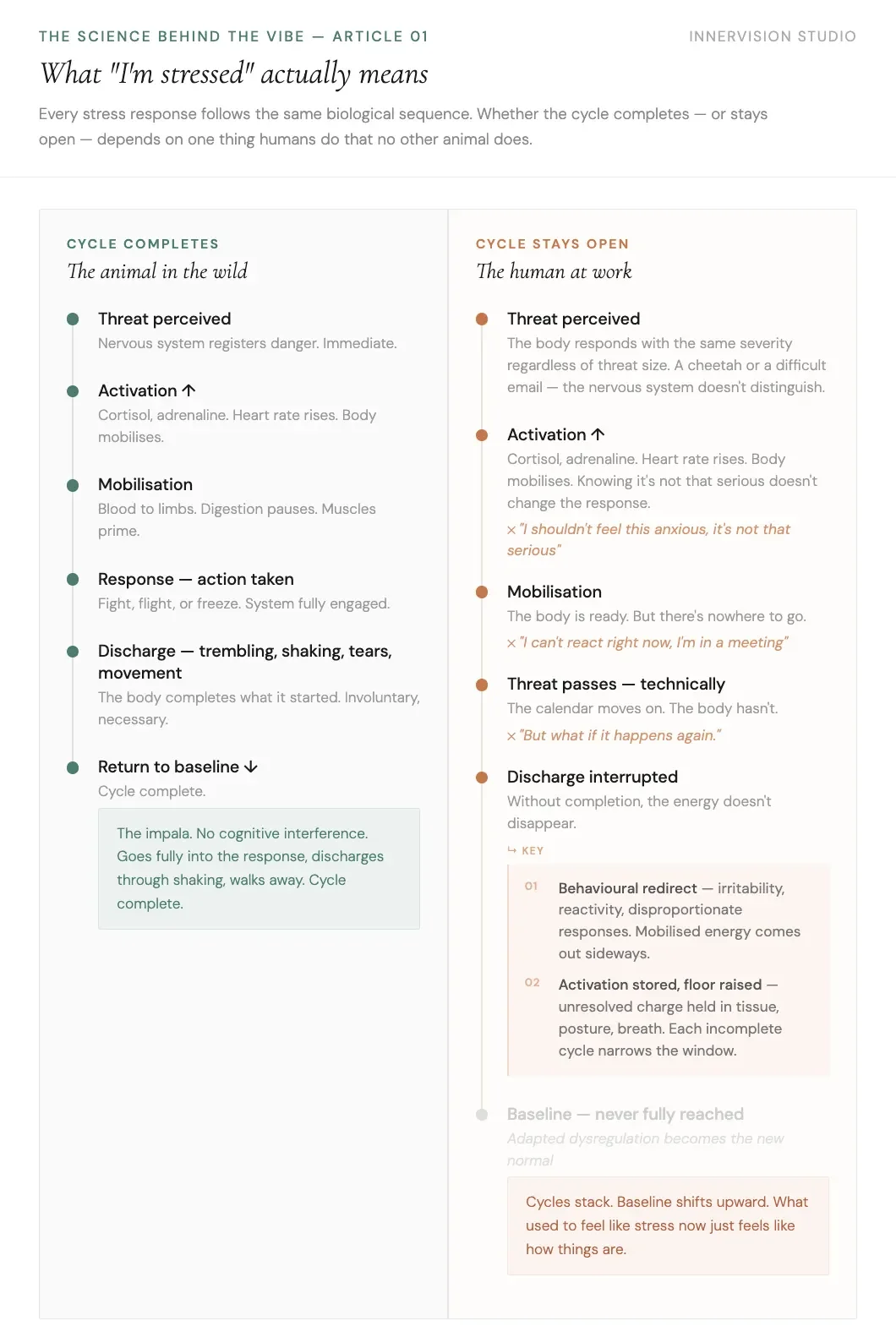
Image Source: Innervision Studio
Whether the cycle completes or stays open determines where your baseline sits and that's where the window of tolerance comes in. The impala moves through all three. Activation spikes, peaks, and returns to baseline — the full arc, completed. For most of us, the cycle interrupts before it finishes. We live somewhere between flooded and flat, rarely fully returning to the regulated middle. That's the window of tolerance — and for most people under chronic stress, it's narrower than they realise.
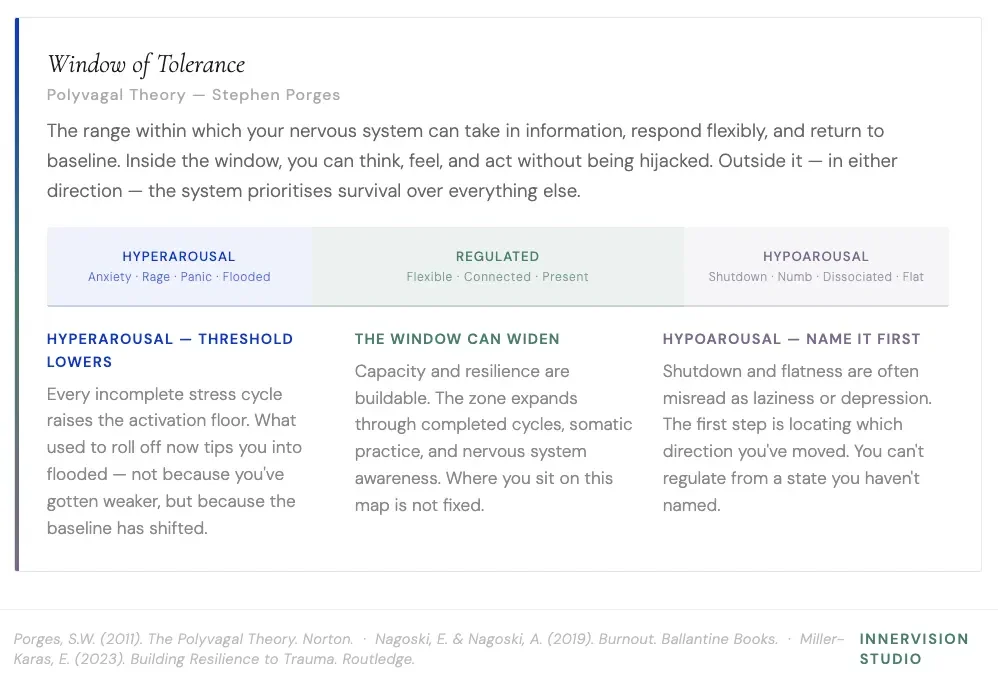
Image Source: Innervision Studio
The impala completes the cycle every time. We don't, and it's not accidental. Here’s what makes humans different.
We override our physical signals through narrative and social conditioning — what we’re supposed to feel, how we’re supposed to behave, what’s appropriate given the circumstances. So when the discharge wants to happen, the irritability that arrives faster than it reasonably should, the urge to cry from something feeling hard and inescapable — we suppress it. “I just don’t have time for this right now.” Or “I’ll deal with it later.” And then later doesn’t come, or it comes as a long weekend sleep that still doesn’t quite reach the bottom of it.
The cycle stays open, the activation doesn’t disappear, but instead accumulates. [3] Each incomplete stress cycle raises the floor and narrows the window for the next one.
Burnout is a regulation problem. Incomplete cycles, accumulated over months or years, are stored in the body. Chronic stress commonly manifests as disrupted digestion, chronic fatigue, and persistent irritability. [4] And when the system tips into hypoarousal and stays there — flatness, shutdown, going through motions — that overlap with depression is well-documented in the research on chronic stress and mood. [5] The narrowed window and the lowered mood aren’t separate problems; they’re the same system past its limit.
If you want to widen your window, that's worth 15 minutes to look at properly.
References
1 — Siegel, D.J. (1999). The Developing Mind: Toward a Neurobiology of Interpersonal Experience. Guilford Press.
2 — Porges, S.W. (2011). The Polyvagal Theory: Neurophysiological Foundations of Emotions, Attachment, Communication, and Self-Regulation. Norton.
3 — Nagoski, E. & Nagoski, A. (2019). Burnout: The Secret to Unlocking the Stress Cycle. Ballantine Books.
4 — Miller-Karas, E. (2023). Building Resilience to Trauma: The Trauma and Community Resiliency Models. Routledge.
5 — Corrigan, F.M., Fisher, J.J. & Nutt, D.J. (2011). Autonomic dysregulation and the Window of Tolerance model of the effects of complex emotional trauma. Journal of Psychopharmacology, 25(1), 17–25.
6 — Rygula, A. et al. (2022). Running from Stress: Neurobiological Mechanisms of Exercise-Induced Stress Resilience. International Journal of Molecular Sciences, 23(21), 13348.